 PupShift
New puppy at home: the first 30 days, week by week
In short
Get the house and the family ready before the puppy arrives, run the same simple day through week 1, then add gentle new experiences, short training, alone time and the leash over weeks 2 to 4. Ask your vet about food, vaccines and anything health-related.
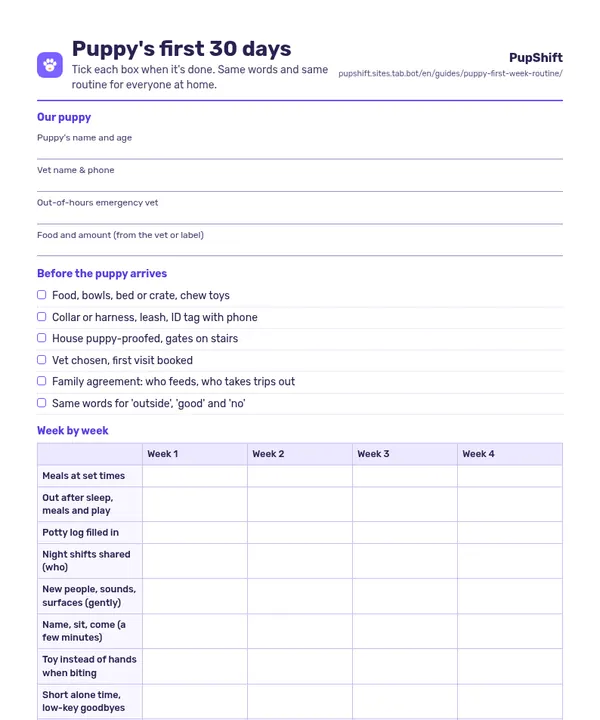 PDF · A4Puppy's first 30 daysDownload PDF
The first month sets a lot in place: habits, trust, and a routine everyone at home follows. This plan takes it one stage at a time, from getting ready before the puppy arrives to a look back at the end of week 4. Write it down, put it on the fridge, and let the whole family work from the same page.
Before your puppy arrives
The basics to get
- The food your puppy eats now. Ask the breeder or shelter what they feed and keep to it at first. If you want to switch later, ask your vet how and when.
- A food bowl and a water bowl.
- A bed or an open crate with a blanket, in a quiet corner that isn't cut off from the family.
- A collar or harness, a leash, and an ID tag with your phone number.
- Chew toys. Puppies chew everything, so it's better if it's the toy and not your phone charger.
- Poop bags, and an enzyme cleaner for accidents.
Puppy-proof the house
Pick up cables, shoes, medicines, cleaning products and plastic bags. Ask your vet which houseplants and foods to keep out of reach. Block stairs and open balconies with a gate.
Pick a vet
Choose a vet before day one and book a first visit for the first few days. Bring every paper you got from the breeder or shelter. Ask the clinic now which emergency service to call out of hours, and save the number in every family member's phone.
Agree as a family
Sit down before the puppy comes and decide where it sleeps the first nights, where the potty spot is outside, and which rooms it can use. Agree on who feeds when and who takes the morning and evening trips outside. Pick one word for going out, one for "good" and one for "no", and write them on the fridge. If one person says "outside" and another says "potty time", the puppy hears two different things.
Days 1 to 3: coming home
Day one. Keep it calm, with no welcome party for the whole street. Let your puppy sniff around at their own pace. Show them the potty spot as soon as you get home, and praise warmly when they go. Puppies sleep a lot, so don't wake them up to play, and ask the kids to let a sleeping puppy sleep.
The first night. Crying is normal: your puppy just left their mom and littermates. Blue Cross recommends keeping the puppy in your bedroom at first, in a bed or crate, and moving it out gradually later. A short trip outside right before bed helps. A young puppy can't hold it all night yet, so expect night trips: quiet, no play, straight back to bed.
Days 2 and 3. Start the routine below, with the same meal times and the same trips outside. Have the first vet visit or call. Ask what your puppy needs and when: checkups, vaccines, parasite protection, and the legal paperwork where you live (see the section on legal duties below).
Week 1: the daily rhythm
The American Kennel Club says most puppies eat four meals a day between 6 and 12 weeks, three between 3 and 6 months, and two after 6 months. How much goes in each meal depends on your puppy, so follow the label and ask your vet or breeder.
An example day for Pepper, 10 weeks old, in a family where both parents work:
| Time | What happens | Who |
|---|---|---|
| 6:30 | Wake up, straight outside | Night-shift adult |
| 7:00 | Breakfast, then outside | Dad |
| 7:30 | Short play, nap in the quiet corner | Noa before school |
| 11:30 | Meal, outside, play | Mom (working from home) |
| 15:30 | Meal, outside, a few minutes of training | Noa after school |
| 18:30 | Dinner, outside, family time | Mom |
| 22:30 | Last trip outside, bed | Dad |
In between, the puppy mostly sleeps, which is normal.
Potty breaks
The AKC's potty timeline says to take the puppy out as soon as it wakes and after meals and drinks, on a leash, so you can see what happens. Add a trip after every nap and every play session.
How long can it hold it? The AKC gives two rules of thumb on two pages. The usual one: about one hour per month of age, so roughly 3 hours for a 3-month-old. The other is an upper limit: age in months plus one, so about 4 hours at most. Plan around the lower number. During the day you'll go out much more often anyway.
Went outside? Praise right away, right there. Accident inside? No yelling. Clean up calmly with an enzyme cleaner and go out a little sooner next time.
The potty log
Keep a log for the first weeks. Each trip gets a line with the time, outside or accident inside, and what happened just before (woke up, ate, played). After a few days you'll see a pattern.
| Time | Outside | Accident inside | Right after |
|---|---|---|---|
| 6:30 | yes | woke up | |
| 7:20 | yes | breakfast | |
| 9:05 | yes | play |
Night shifts
Nights are the hard part, and often one parent ends up doing all of them. Split them on purpose:
- Alternate nights. One adult takes nights 1, 3, 5 and 7, the other takes 2, 4 and 6. Whoever is off sleeps and takes the morning.
- Or split the night. One adult until 2:00, the other after.
- Keep it boring. Blue Cross advises against leaving a new puppy to cry, and says night trips should be calm and quiet so the puppy doesn't learn that night is playtime. Out, potty, back to bed.
- Write down the last trip. The morning person then knows when the next break is due.
Week 1 at a glance
| Day | Focus |
|---|---|
| 1 | Arrival, quiet corner, potty spot, first night in your bedroom |
| 2 | Same meal and potty times, start the log |
| 3 | Vet visit or call, put the answers on the fridge |
| 4 | Name game: say the name, reward the look |
| 5 | Gentle household sounds, one calm visitor |
| 6 | Read the potty log, adjust trip times |
| 7 | Family check-in: what worked, who needs a break |
Week 2: meeting the world
PDSA explains that a puppy's socialization period runs from about 4 to 12 weeks, and many puppies come home at around 8 weeks, right in the middle of it. Gentle, positive experiences now help your puppy cope with the world later. Short and calm beats long and busy.
- People: men, women, children with a parent, people in hats, glasses or a hood. Each one offers a treat and lets the puppy come to them.
- Sounds: the vacuum, the doorbell, the washing machine, traffic. Start quiet and far away.
- Surfaces: grass, tiles, carpet, a doormat, a low step.
- Handling: touch paws, ears and mouth gently and briefly, with a treat. It helps at the vet and at grooming time.
- The car: sit in it with the engine off, then a short drive.
If your puppy gets scared, don't push. Back off a little, let them watch from a distance, and try again another day.
Before the vaccines are done: ask your vet when your puppy can go out on the ground and meet other dogs. Until then there's still plenty to do: at home, carried in your arms to watch the street, or with healthy vaccinated dogs you know, if your vet agrees.
Week 3: first cues and puppy biting
Short sessions, many times
A few minutes at a time, a few times a day, and stop while it's still fun. Start with:
- Their name: say it, they look at you, they get a treat.
- Sit: hold a treat above their nose and move it slowly back. As their bottom goes down, say "sit" and give it.
- Come: start one step away, indoors, and celebrate every time they come. Never call them to scold them.
Everyone at home uses the same words and the same rewards, so the puppy learns one language, not four.
Puppy biting
Puppies explore with their mouths. Blue Cross describes play biting and mouthing as a normal phase and suggests redirecting it:
- Keep toys within reach and offer one when teeth reach your hands.
- If the puppy bites hard, pause the play briefly so biting ends the fun.
- A tired or overexcited puppy often bites more. Sometimes the answer is a nap.
- Children play with the puppy only with a parent there, and swap hands for a toy.
Week 4: alone time and the leash
Alone time
Blue Cross suggests building alone time in small steps: first a few minutes behind a baby gate with you still in the house, then short trips out of the house, returning before your puppy gets anxious. Leave a chew toy, keep goodbyes and hellos low-key, and move at your puppy's pace. Some puppies take a few days, others longer.
The leash
Start indoors, a few minutes a day, with treats: let the puppy wear the collar or harness, then the leash, then take a few steps together. The AKC notes that a harness puts no pressure on the neck if the puppy pulls. Move outside once your vet says it's OK, and keep the first walks short.
A look back
At the end of week 4, sit down as a family. How many accidents this week compared with week 1? Which cues does your puppy know? What still worries them? Who has been doing most of the work? That's your plan for month two. A puppy class or a trainer is worth considering, especially if something isn't working.
When to call the vet
With a young puppy it's better to call and ask than to wait and see. Call your vet, or the emergency service they told you about, if your puppy:
- isn't eating or isn't drinking
- vomits or has diarrhea more than once, or you see blood
- seems weak, listless or doesn't want to move
- may have swallowed something they shouldn't have
- shows anything else that worries you
This guide is general information. It doesn't replace your vet or a trainer.
Legal duties by country
Rules depend on where you live and can change, so check the official source for your area. What we found on official sites in October 2026:
- United States: there's no single national rule. Rabies vaccination for dogs is set by state law, and cities and counties can add their own rules, such as a dog license. Ask your vet what's due, and check your city or county website for licensing.
- United Kingdom: GOV.UK says all dogs must be microchipped and registered by the time they're 8 weeks old, so your puppy should arrive chipped. Make sure the microchip database has your details. In Great Britain, a dog in a public place must wear a collar with the owner's name and address on it or on a tag (Control of Dogs Order 1992). In Northern Ireland you also need a dog licence, and nidirect says it's an offence to take a dog before you have one.
- Canada: dog licences and vaccination rules are set by your province and your city or town. Check your municipality's website and ask your vet.
- Australia: rules differ by state and territory, and your local council handles registration. In NSW, for example, Service NSW says pet dogs must be microchipped and registered from 12 weeks of age, or when ownership is transferred. Elsewhere, check your council's website.
The 30 days at a glance
| When | Focus |
|---|---|
| Before | Shopping list, puppy-proofing, vet chosen, family agreement |
| Days 1 to 3 | Calm arrival, first nights in your room, first vet visit or call |
| Week 1 | Same day every day, potty log, night shifts |
| Week 2 | New people, sounds, surfaces and handling, gently |
| Week 3 | Name, sit, come; redirect puppy biting |
| Week 4 | Short alone time, leash indoors, family look back |
Where PupShift fits
On PupShift, the whole family logs the puppy's meals and walks on one board, so everyone sees who did what. Potty training has its own Outside and Accident inside buttons, with the last two weeks on a chart.
This is general information, not a substitute for advice from a vet or trainer. If something seems wrong with your dog, call your vet.
Sources
- Puppy Potty Training Timeline and Tips American Kennel Club
- How To Potty Train a Puppy American Kennel Club
- Puppy Feeding Fundamentals American Kennel Club
- How to get your puppy to sleep through the night Blue Cross
- Puppy socialisation PDSA
- Puppy biting and mouthing Blue Cross
- Preventing separation anxiety in puppies Blue Cross
- How to Train a Dog or Puppy to Walk on a Leash American Kennel Club
- State Rabies Vaccination Laws for Domestic Dogs, Cats, and Ferrets CDC Public Health Law Program
- Get your dog or cat microchipped GOV.UK
- The Control of Dogs Order 1992 legislation.gov.uk
- Dog licensing and microchipping nidirect (Northern Ireland)
- Register your dog or cat in NSW Service NSW
Checked on the update date.
This is general information, not advice from a vet, trainer or other professional.