 PupShift
Dog schedule for working families: a weekday plan that covers the gap
In short
Build the weekday around three fixed points (a proper morning, a covered middle of the day, and an evening that belongs to the dog), give each slot a named person and a backup, and check one shared record so nothing is missed or done twice.
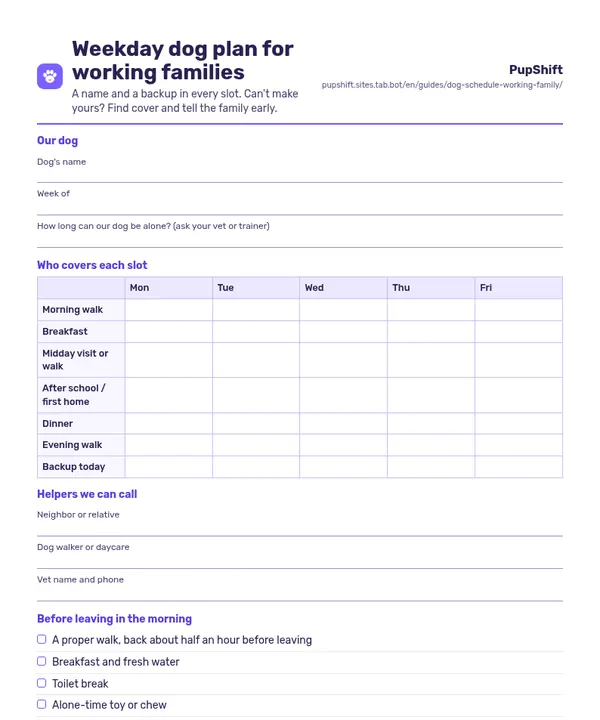 PDF · A4Weekday dog plan for working familiesDownload PDF
When both adults work and the kids are at school, the dog's day has a hole in the middle. The fix isn't heroics. It's a plan: who does the morning, who covers the middle of the day, who takes the after-school slot, and who steps in when someone can't. The example family: Pepper the dog, Mom (office three days a week), Dad (leaves at 7:15), Noa (11) and Ari (7).
Map the empty hours
On one sheet, draw the weekday from wake-up to bedtime and shade the hours when nobody is home. Do it per day, because hybrid work and after-school activities make every day different. In our example the house is empty from 8:00 to 14:00 on Mom's office days, and only until 12:30 on her home days.
Then ask how long your dog can comfortably be alone. That depends on the dog. The RSPCA advises leaving a dog alone for no longer than four hours, so they have chances to exercise, go to the toilet and spend time with people. Puppies, older dogs and dogs who find being alone hard may need less. Your vet or a qualified trainer can help you work out what's right for yours.
Make the morning count
The RSPCA's tips for leaving a dog are simple and fit a weekday morning well: exercise your dog before you leave, aim to be back from the walk about half an hour before you go, make sure they've been to the toilet, and give them something to occupy them while you're out.
So the morning slot is the anchor of the day:
- A real walk, not a quick lap, by whoever leaves last or has the most time. In our example that's Dad at 6:30.
- Breakfast at the same time every day. How much to feed is a question for your vet.
- Fresh water, a toy or long-lasting chew kept just for alone time (the RSPCA suggests a "special" toy given only when you go out), and a calm goodbye.
Cover the middle of the day
If the empty stretch is longer than your dog can manage, something has to fill it. Options, roughly from cheapest to most organized:
- Someone comes home at lunch. Works on work-from-home days or for a parent who works close by.
- A neighbor, friend or relative who's around in the day. Agree on the days, give them a key and the routine sheet, and thank them properly.
- A dog walker for a midday walk on the long days only.
- Doggy daycare on the longest days. The American Kennel Club suggests visiting first, asking how dogs are grouped and supervised, and making sure staff know what to do in an emergency. Not every dog enjoys daycare, so watch how yours copes.
If someone outside the family helps, give them the essentials in writing; our dog sitter handoff sheet is a good template. Mix them. Our example family uses a walker on Mom's three office days and Mom's own lunch break on her home days. Whoever does the midday visit marks it in the record, so everyone knows it happened.
Share the after-school and evening slots
The first person home has the after-school slot: let the dog out, a short walk or play, fresh water. If an older child is first home, set it up with a parent: the walk happens with an adult or on a short, agreed route, and a parent checks in by phone. In our example Noa takes Pepper around the block at 14:30 on Mom's home days, with Mom at home.
The evening is the dog's time with the family: dinner at a set time, the longer evening walk, a few minutes of play or training. Rotate the evening walk between adults (our guide to splitting dog chores fairly has more on rotations) so it isn't always the same tired person. Ari can help measure dinner with a parent and fill the water bowl.
| Slot | Mon | Tue | Wed | Thu | Fri |
|---|---|---|---|---|---|
| 6:30 walk + breakfast | Dad | Dad | Dad | Dad | Dad |
| Midday | Walker | Mom | Walker | Mom | Walker |
| After school | Mom | Noa + Mom | Mom | Noa + Mom | Mom |
| 18:00 dinner | Ari + Mom | Ari + Dad | Ari + Mom | Ari + Dad | Ari + Mom |
| Evening walk | Mom | Dad | Mom | Dad | Mom |
Name a backup for every slot
Work runs late, buses break down, kids get sick. For each slot, write a backup name next to the main one, and agree on one rule: if you can't make your slot, you find cover and tell the family, early.
Keep a short list of people who can step in on a bad day, with phone numbers, on the routine sheet.
Keep one record and review weekly
With several people and a walker involved, the risk is gaps and doubles: nobody walked her at lunch, or she got two dinners. A single record that everyone marks right away, with a name and time, solves both.
Once a week, take ten minutes: what got missed, what changes next week (a late meeting, a school trip), and is the dog coping with the routine? The AKC notes that dogs feel more secure with a predictable routine, and that if you need to change it, doing it gradually helps. If the plan changes, update the sheet on the fridge.
Common mistakes
- Planning for a "typical" day when every day is different.
- No backup, so one late meeting leaves the dog alone all day.
- A rushed two-minute morning lap, then a long day alone.
- Treats given for alone time on top of meals. The RSPCA reminds owners to take treats out of the daily food allowance.
Where PupShift fits
PupShift is one board for the whole family. Whoever feeds or walks Pepper taps Fed or Walked, and everyone sees who did it and when. You can send your dog walker an outside helper link, so their midday walk shows up on the same board while you're at work, and they can't change or delete anything. If someone taps Fed again within 2 hours, the app checks first and shows who already logged the meal. For the fridge, there's the printable on this page.
This is general information, not a substitute for advice from a vet or trainer. If something seems wrong with your dog, call your vet.
Sources
- Training your dog to be left alone RSPCA
- Choosing a Doggy Daycare American Kennel Club
- How to Change Your Dog's Routine American Kennel Club
Checked on the update date.
This is general information, not advice from a vet, trainer or other professional.